Living ...things...
There are many living... things in Holland. There is not always a line between plants and animals, there is no line between edible and poisonous, and most of all, the line between living and euthanised is rather thin. No intelligent being inhabits Holland. Those who were, have destroyed their brain cells by smoking too much Nederwiet in order to forget the past.Humans
The humans in Holland are about 175 cm tall and very skinny because of the hunger. They have the ability to swim; those who have not, have the ability to drown (legal). They are ripe for mating as soon as they can pay their red-light-taxes. Average lifespan is 40 years, meaning a midlife crisis can strike at twenty. During the war, many infertile mutants came to life. The Tourist Breeding Program in the Scrambled States has led to the stable mutant Homo Tourista americanii that can mate with Dutch humans with a quite disappointing result.
Rats (Lapinis Aquaea belgica, Ondatra zibethica mutatis)
The rat used to be a real enemy of human. It crawled itself a way through the dikes, leaving dangerous holes. Fortunately, the Lapinis Aquäa belgica tastes delicious (especially with a lot of mayonnaise), so the animal is hunted by the hungry and is now close to extinction.
Rats mate twice a day, without paying any taxes. They have 6 baby rats each month. After about 8 weeks, the young rats are edible.
Winter Frog (Rana Nuclaea roterodamus)
The winter frog appeared in the Nuclear Winter southeast of Rotterdam. It seems to be a mutant frog/toad offspring. It has 6 legs, 3 on each side, and no tail. It’s up to 15 cm long and just as tall. The mouth is large, the eyes bulking and its throat can reach enormous volumes. It’s skin is furry and has a blue-green, so it can’t be seen in it’s natural environment. Unfortunately, this environment has been destroyed and the Winter Frog is now a colourful addition to the grey-and-brown Dutch landscape.
The singing of the Winter Frog, on warm evenings and nights, is excellent. Dutch radio producers as well as the Phillips Gramophone have offered contracts to have the Dutch concerts recorded.
In winter, the Winter Frog hides away in the ditches and waits in its furry coat till the spring breaks through the ice. Because it has nothing else to do under the frozen water, it mates. In spring, the eggs are brought into the sunlight, right under the layer of ice. Here the eggs give birth to the Fingerfish. After its first summer, the Fingerfish hides in the ditches and comes out as an adolescent Winter Frog. It is not know which age the Winter Frogs can reach, many are served to French tourists (with a lot of sauce hollandaise) before they reach that age.
Fingerfish (Rana N.r. junior)
Fingerfish are the children of the Winter Frogs. They are about 20 cm long, including a tail. In the first weeks of their lives, they grow short arms just under the neck. These arms have hands, and those hands have the famous fishfingers. These taste delicious even without mayonnaise. Hence, the Fingerfish is often hunted.
Herring (Haringa Hollandus)
Herrings are very edible and belong to Holland’s best hunted fish. In the salty lakes that have been left after the Flood, several kinds of Herrings live: the Maat (H.H. Maätus), the Rollmop (H.H. Augurkus) and the Kipper (H.H. Smokus). In the open sea, the somewhat larger North Sea Herring (H.H. Vulgarus) lives. Herrings are eaten with onions to camouflage the taste. Once, a certain Willem Beukelszoon invented a way to keep herrings longer fresh, but that knowledge has been forgotten a long time ago.
Eel
The eel comes in two species: the Anguilla Electra (Lightning Eel) and the Anguilla Angelius (Spicy Eel). The latter is about 30 cm long and edible. The Anguilla Electra is not edible, but is a source of electricity. During the Double Dutch War, a Harmen van der Sloot set up a Eel Power Station to trade their natural electricity. The project failed, because Van der Sloot forgot to feed his eel collection.
Seagulls
The seagulls have mutated in three different species after the Mokum Meltdown. Best known are the screaming seagulls (Larus Candius), that have their typical call that rings over the flat lands when they are looking for a bit of food (Winter Frogs, mostly). They are white when they are born, but fade to grey soon after. Their head stays black. They have a red spot on their beak, many humans believe that is the button that can turn them off.
There is the Diving Gull (Larus Baptista) that can dive very deep into the mud to catch its prey. It usually has a brown hue, but no-one can tell what is under the layers of mud. Real old Diving Gulls are so heavy from the mud they are no longer able to fly. They are an easy prey, but there is no market for the disgusting, salty, oily Diving Gull.
The Vulture Gull preys upon the leftovers of euthanised animals and humans. It lurks around the deathbeds of the once who have caught the Dutch Disease. It is seen near the dwellings of famous euthanisers. The Vulture Gull has become a symbol of Death.
Cows
The common cow is nearly holy to the Dutch. Cows provide milk, which is used to make cheese. Eating cows would be a disaster to the cheese trade. However, cows that don’t give milk (such as bulls) are very edible and welcomed on every dish. At the remains of the Wageningen Agricultural University (the Netherlands), a breeding program researches the possibilities of having both male as female cows giving milk. The Holland Dutch are against this gen-tech, because, they claim “they at the WAU are a bunch of vegetarians and we need our steaks before we turn into cannibals”.
Potatoes (Potata Fria vulgaris)
Young potatoes come out of the mud, and harden their many thin white legs in the dimmed light of the sun. Once their legs are stiff enough to walk on, they open their many eyes to face the cruel world. After a few weeks, they develop their tiny wings, that keep them upright when their bulky, inelegant bodies race over the fields. In spring, the wings fall off. The Potato hides in the soil for a few weeks, to breed offspring. After that, the wings return as a sign the mating can begin again.
The potato is easily scared, which does it make a bit complicated to hunt. There hasn’t been found a way to breed them in greenhouses yet.
The potato is well known in Holland, and usually comes in the varieties “patat” or “friet”; the bodies are chopped into long sticks and fried in hot oil. They are served with a lot of mayonnaise and a pinch of salt. Other accepted methods to devour the creatures include cooking alive in boiling water and chopping them to slices and bake them. Wings and legs are not edible. The eyes are poked out before eating.
Pigs
There should be some pigs around. Pea soup should have proper pork in it. Yet no pigs have been found recently. Either something else is used in the soup or the pigs have found a way to mingle among the Amsterdam tourists without being noticed by the locals.
Beetles
There are some. Some are edible. Those who have themselves spelled Beatle certainly are not. Most beetles can be found in A2-City, where they rust away on their four wheels.
Malaria-mosquito
Since the floodings, some of the swamps are ridden with mosquitoes. Most carry the malaria-parasite. Only smoking enough Nederwiet might scare the mosquitoes away. Unfortunately, smoking in the swamp can be very dangerous.
Cannabis Sativa hollandia
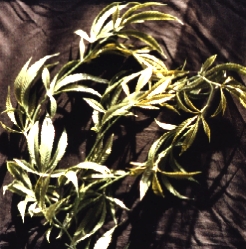 The most famous of Dutch plants is the Cannabis Sativa hollandia, called Nederwiet by the locals. It used to be a harmless plant that had some strange effects to the human mind. However, having been exposed to Fallout has turned this plant into a very strong resource of all kinds of medicines. It relaxes the paranoid, it enlightens the brothers of darkness, it cures certain needs, and it makes people forget.
And above that all, there... the Nederwiet... oh, come on, what was it? I can’t remember what I was going to write.
Toebac
A good joint needs tobacco. Now the Queen had New York nuked, none of the Scrambled States, including Cuba, is willing to export tobacco to Holland. Come to think of it, none of the other states in the world wants to export tobacco to Holland, because of its extreme tax rate.
However, the Dutch created Toebac, a fine substitute for tobacco. It is grown on the mountain-ridge along the river Rhine, where alpine workers with extra oxygen harvest the golden leaves.
Tulips
Once dragged in from Turkey, the Dutch now have their very own kind of tulips in all colours of a Nederwiet-inspired rainbow. To the Dutch, the colour is not that important, what counts is the taste of the bulb. Good, young bulbs are cleaned and then sliced. These slices are toasted and then eaten. With a bit of cheese and a bit of mayonnaise, no one will complain.
The vast fields filled with tulips made it necessary to have the Hippy army camouflaged in a tulip-pattern uniform.
Tomatoes
Being a dangerous weapon, tomatoes are prohibited in Holland. The fruits (vegetables? Who cares, they are unedible) are exported to Germany, where the Spandau Prison is the biggest consumer. They are nicknamed “Waterbombs” but since the flood they have more taste than water: they taste like mud.
Pimmetjes
A small mushroom this is, with a head that is almost human. But most gatherers of this mushroom are not concerned about the pitiful look of that head. They just pull them out of the soil, have the mud wiped off, then take the Pimmetjes home to dry them. After a while the heads are shrunken, but the effects have grown. Eating Pimmetjes gives nice hallucinations, such as a world without taxes or a life with dry feet.