Dogs, goats, urx
There are small wagons and carts that are pulled by dogs or goats. The "doggycars" are used for transport in the inner city and on markets. The cheap cars, lean, small and easy to navigate through the crowd are very popular by lower and middle class merchants. Both dogs and car are cheap and small, so it it the ideal means of transport for the poorer people of Daleth. However, the dogs are not strong enough to pull a cart that is too heavy. To have more dogs to pull the car is too expensive for most people who own a car like this.The goat cart is uses by the poorer farmers who can not afford a horse. They use the goat cart to transport the goods and produce from their farms to the markets. Richer people do have goat carts too. They buy these for the children to play with on the estate. The carts are miniature copies of the larger carriages that are used for pleasure rides by the upper class.
The urx, a kind of cow, is much stronger but seldom seen in Daleth. Original from the Unknown Territories, the urx pulls the wagons and caravans of the nomads in that part of the world. Urx smell awful and need special food, therefore they are not popular in Daleth. Some market people take an urx to the foor, but that is more for show purposes.
Horses and donkeys
Simplest is to travel by horse. Many families do own a horse for this purpose, farmers have horses to work on the land, but do also travel with them if necessary.There are several kinds of horses. A horse is a horse of course, but breeding and training give the animals a different accent. There are farm horses, who are strong enough to plough the land, coach horses, who are trained to pull a coach or a chariot even in a hectic crowd, the dumb mill horses, used to power a mill or a crane by walking in circles or in a wheel, the swift mail horses, who can walk very fast over the roads, warhorses, trained in battle, and so on. Hufa is a famous place for horse breeding.
A horse is expensive (50 Skatts and upwards) but fast, a well trained mail horse can travel from Ildritz to Altheizar in just one day - but is then exhausted. Many guest houses provide an exchange service for horses: you hand over your tired horse and get a fresh one to travel on if you are in a hurry; when you come back you can pick up your own horse again.
Donkeys are less expensive (20 Skatts and up), but not half as quick. They pull well, but donkey back riding can be too much. Donkeys are great to be used in the mountains, though.
Coaches and other horse powered vehicles
The most common way of transport, apart from walking, is taking a horse powered car. There are a lot of different models to pick from. Should it have one horse, two, three, four or even more? Two or four wheels? Should it be convertible to a sleigh? You want a top roof or a tilt-car? A standard wooden car you can ride on to the next market, or a luxurious chariot you can relax in during your journey? Almost everything is possible - and if what you want is not available, it might be custom made.How many horses?
The one-horse option is for the not too heavy carriages on easy terrain. The two horse option is more or less normal outside the cities. Three horses are found in rural areas, where the roads are broad. Four horses are used for the heavy stage coaches on long journeys. Six horses and up is more or less a question of standing: middle class can have no more than six horses in front of a private carriage, upper class is limited to eight, and only the royals may have more on official occasions.
Two wheeled carriages
Cariffe
The cariffe is a small two wheeled carriage without a roof, pulled by one horse. The passengers and the driver shelter under a piece of waxed cloth from rain and/or under a blanket from cold. The cariffe is owned by the driver, who drives through town, looking for passengers. The light, compact construction makes the cariffe rather fast and easy to turn. The ideal carriage in the cities, and therefore very popular by the people who can afford the ride (about 2 Assar for a short ride) but not their own carriage.
Outside the city the light construction might be too fragile for the badly maintained roads, although the cariffe is provided with springs to have a comfortable ride over the cobblestones of the city streets.
Tainjo
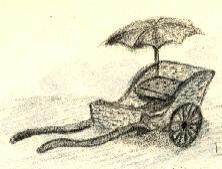 The Tainjo is a small two wheeled, one horsed carriage. It is made of woven reed and willow twigs, a very light structure, on a tough wooded frame. It usually has a large basket of the same light material on the back where the pick nick things are in. The Tainjo is a leisure carriage, to go out in the open, to meet the tranquillity of the landscape. There can be a canopy over the Tainjo, to prevent the passenger from getting too hot in the sunlight and from getting wet by the gentle summer drizzle.
Four wheeled private cars
Caravan
Foorfolk and the traders of Salamandran have caravans to live in. Their caravan is their mobile home, and sometimes their mobile office. The caravan is made of wood, has four wheels and is pulled by one or two horses. Springs are not common, and therefore, most caravans won't do a fast drive even if they could.
There is a door immediately behind the coachman's seat, which is more or less a veranda, where the female folk will grow flowers and herbs. This little balcony is the place where the laundry is dried, where the children play and where the family sits during the drive. On foors, it is the little stage where a show takes place or from where the goods are sold.
Inside the caravan, place is sparse. It is high enough to stand upright, and broad enough for a bed placed square on the riding direction.
The back end of the caravan has two or three beds above each other. There are windows with shutters?? at the back to provide some light and privacy in the beds. These beds are for all members of the family, sometimes ten or more persons.
Just behind the entrance door are a washing table with a water container, and a high closet. The middle of the caravan is empty. It has windows here, and there is plenty of room for chairs and a table. Many caravans have bunks or chests attached to the walls to sit on and/or to put things in. More room to put things in is at the outside of the caravan, under the beds, and under a trapdoor in the floor that gives access to a large chest.
Some caravans have a build-in stove with the possibility to cook on it. Others have to do with mobile stove or a campfire.
Fana, Tilty or tilt-car
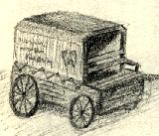 The tilt-car is a poor mans caravan, some say, but that is not all true. Of course, there are families who drive from foor to foor in a tilt car because they can not afford anything else. But there are others, who live in a house and use their "Tilty" to travel to a foor, make money, and return home.
Others
SledgesIn the northern parts of Daleth and in winter, one cannot travel without a sleigh. There are many models, from simple and small to expensive and luxurious. Comfortable are the "compatible" carriages, that can be taken from the wheels to be set on the frame of a sleigh.
Ryros
A strange vehicle, the ryros. The person riding it, has to move it himself with his feet and legs. It has two wheels, a saddle, and a steering installation. One should sit on the saddle between the front- and hind wheel and then move the thing with ones feet. When speed is gained, the ryros will go on driving for a while without using the feet, especially when going downhill. However, braking stays a problem. The anchor on the back of the vehicle stops the ryros very suddenly, and in most cases the driver will fall off. The manufacturers of the ryros still try to find a solution.
Millstone Road
A Millstone Road is a road on the hill- or mountainside. It is specially designed to get millstones down the slope. Some millstone roads are used to get ore down. The track should be kept clear, so the stones can tumble down freely. Most millstone roads are deep with stone roadsides to prevent the stones from choosing a different track. Sometimes the millstone road uses an old riverbed or a brook.
People are not allowed to walk in millstone roads. There are bridges over the roads, and fences next to it. The fences must be high and strong enough to keep animals from falling in the millstone road.
Scholvanian Carriage
To allow the emperor to travel over the steep roads of the Black Mountains, the Scholvanians invented a horseless, wheelless carriage. Two long poles on either side allow servants to carry the carriage over the steps and rocks of the bumpy roads. The carriage itself is suitable for one person. It has windows that can be opened, curtains, a comfortable seat with a heated foot-warmer, a roof and storage place under the seat.
Related topics: